
Organizations

Half of Canadians struggle with winter hydration because the symptoms are invisible until they become a bathroom emergency. Most people do not recognize the need for a solution until the problem is already undeniable.
The Challenge:
The campaign uses that specific, uncomfortable signal to frame Liquid I.V. as a functional tool for the Canadian climate. By researching the audience's actual habits and frustrations, the work bypasses standard wellness tropes to create messaging that respects the customer's intelligence.
The Strategy:
The final copy and imagery avoid aspirational lifestyle shots in favour of deadpan honesty. The project demonstrates that understanding a physiological pain point is more effective for building brand loyalty than shouting about wellness.
The result:

Non-profit retention research is notoriously dense and difficult to digest. Most data-heavy reports on the subject are ignored because the presentation lacks a human connection to the people doing the work.
The Challenge:
The strategy involved months of interviewing non-profit staff and analyzing retention data to find the specific frustrations that cause staff to leave. Instead of a standard data dump, the work synthesizes those findings into a narrative that addresses the emotional and practical realities of non-profit support.
The Strategy:
The final feature article transformed technical metrics into an accessible, engaging guide. The project proves that complex research can be made readable without stripping away the nuance or the data's integrity.
The result:

Two Macaws is an Exchange District staple with a specific, soothing atmosphere that is challenging to translate into a formal business context. The goal was to capture the shop’s community-centred identity for a Chamber audience without making the narrative feel forced or losing the professional depth expected by the readership.
The Challenge:
I interviewed the owner, Noor, to move beyond surface-level aesthetics and define the underlying business philosophy. By highlighting practical details—spinning records, local artisan goods, and a free library—I framed participatory commerce as a deliberate strategy for building loyalty through human interaction. The work focused on how a business can use its environment as a primary value proposition.
The Strategy:
The feature article proved that a local business’s community impact can be communicated to a professional audience without sacrificing authenticity. The project demonstrated that a brand’s original voice is a viable professional asset when the narrative is grounded in strategic intent rather than just vibes.
The result:
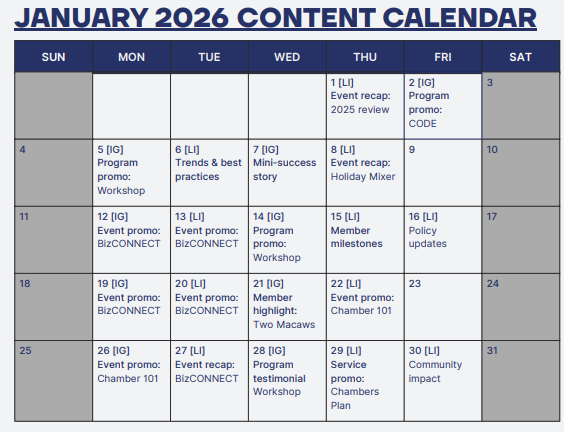
The Winnipeg Chamber of Commerce communicates with a membership ranging from independent retailers to major insurance firms. The problem was a scattered content output that functioned more like digital noise than a professional resource for the local business community.
The Challenge:
I conducted a SWOT analysis to determine where the organization’s messaging was being ignored. By researching the specific frustrations of local business owners, I built a calendar that prioritizes relevance over high-frequency posting. The strategy ensures the Chamber only speaks when the information provides actual value to the membership.
The Strategy:
The final calendar and analysis provided a functional system for the organization's communications. The project demonstrates that even administrative tasks require a strategic foundation to maintain professional authority and build genuine engagement with a skeptical business audience.
The result:

The State of the Province address is a high-density event filled with political performance and broad economic promises. The Chamber needed a news release that could summarize the 2026 address for the media and a membership of busy business owners who don't have time to sift through a two-hour speech for the "why."
The Challenge:
I analyzed the address to identify the specific policy points that would actually affect the local business community. The strategy was to strip away the political fluff and lead with the practical implications for the membership. The work involved translating government-speak into plain, professional English that respects the reader's intelligence and their schedule.
The Strategy:
The final news release provided a concise, authoritative summary that the media could use immediately. The project proves that even a formal government update can be made accessible when the messaging focuses on the audience's needs rather than just repeating the speaker's talking points.
The result:

Audiences ranging from teenagers to everyday consumers are consistently unmoved by aspirational advertising. Whether it's a "just a comment" mentality around online harassment, a pantry staple that never makes it to the stovetop, or a rewards card promising luxury nobody actually lives — the common thread is messaging that misses where people actually are.
The Challenge:
Each project replaces aspiration with honest observation. By using familiar visual language — a smartphone keyboard, a weeknight dinner, a coffee shop receipt — the work meets audiences inside their real habits rather than projecting an ideal onto them. The strategy across all three is the same: find the human truth first, then build the message around it.
The Strategy:
When advertising reflects reality instead of performing it, audiences pay attention. These projects demonstrate that utility, self-awareness, and deadpan honesty consistently outperform lifestyle imagery with audiences who have learned to tune out the noise.